Implemented — Public
Verifiable implementation evidence exists in the public repository.
Open to Applied AI · Generative AI · Agentic AI · RAG · AI Platform roles
Applied AI Engineer
I’m a software engineer with 3+ years across enterprise and regulated pharmaceutical systems, now focused on Applied AI. I build LLM, retrieval, agentic, and backend systems around explicit state, authorization, evaluation, observability, and recovery.
Generative AI & LLM Applications · Agentic AI · RAG & Retrieval · AI Platform & Backend · AI Product Engineering
Evidence model
Public implementation, broader private work, active development, and roadmap direction stay explicitly separated.
Verifiable implementation evidence exists in the public repository.
Broader implementation exists outside the recruiter-safe public repository.
Actively being developed or strengthened.
Architecture or roadmap direction; not claimed as implemented.
Engineering focus
The portfolio is organized around implementation evidence: model behavior, application logic, backend architecture, governance, reliability and evaluation.
LLM applications, structured outputs, full-stack AI products, model routing, evaluation, and grounded workflows.
LangGraph and MCP workflows with explicit state, policy gates, human approval, controlled tool execution, checkpoints, and recovery.
Hybrid BM25 + pgvector retrieval, reranking, citations, versioned evaluation, and measurable retrieval quality.
Python/FastAPI services, PostgreSQL, Redis/Kafka runtimes, identity, observability, cloud delivery, and reliability engineering.
ABOUT
I’m a software engineer with 3+ years across enterprise and regulated pharmaceutical systems. I started with Python/SQL data workflows, enterprise search, document processing, ETL, testing, and automation before moving into LLM applications, retrieval, agentic systems, and AI backends.
The problems I care about are usually around the model rather than just the model itself: what is allowed to execute, what state is authoritative, whether retrieval can be measured, how evidence stays traceable, and how a system behaves when a provider, workflow, or deployment fails.
PROFESSIONAL EXPERIENCE
Experience spans Applied AI, enterprise software, regulated data systems, APIs, retrieval, evaluation, reliability, and production-oriented engineering.
SPACTR AI Labs LLC
Independent engineering across connected Applied AI systems spanning agentic workflows, regulated RAG, AI backends, and full-stack AI products.
SolutionsMax Technology Services Inc.
Worked on Python/FastAPI backends and AI-assisted document workflows for enterprise and pharmaceutical software.
SolutionsMax Technology Services Pvt. Ltd.
Worked across Python, SQL, enterprise search, document processing, data workflows, automation, and regulated pharmaceutical systems.
Flagship engineering
The flagships show the deepest Applied AI work: governed agentic systems and evidence-centered regulated AI.
Flagship 01
Flagship · Agentic AI / AI Platform
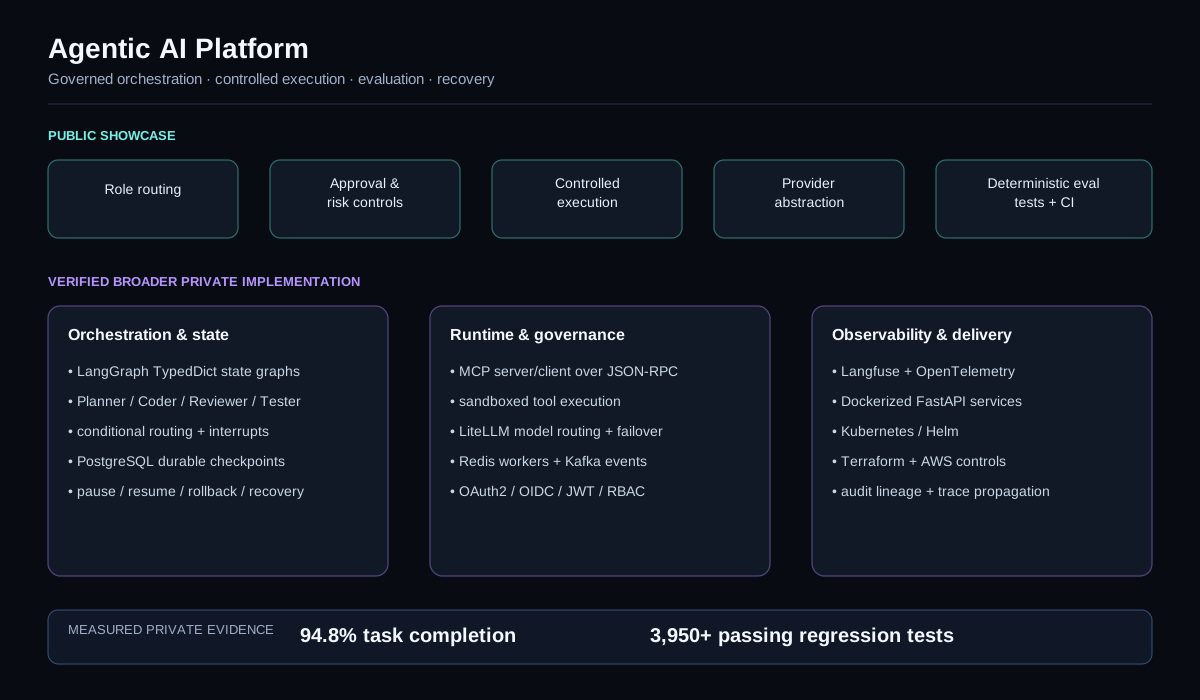
Governed agent orchestration and controlled execution
Built around one rule: planning is not authorization. The platform separates agent proposals from permission to execute, using policy checks, human approval, controlled MCP tool paths, durable checkpoints, rollback, evaluation, and auditability across a broader LangGraph-based runtime.
How can AI agents do useful software work without letting model output become execution authority?
Flagship 02
Flagship · Regulated AI / RAG
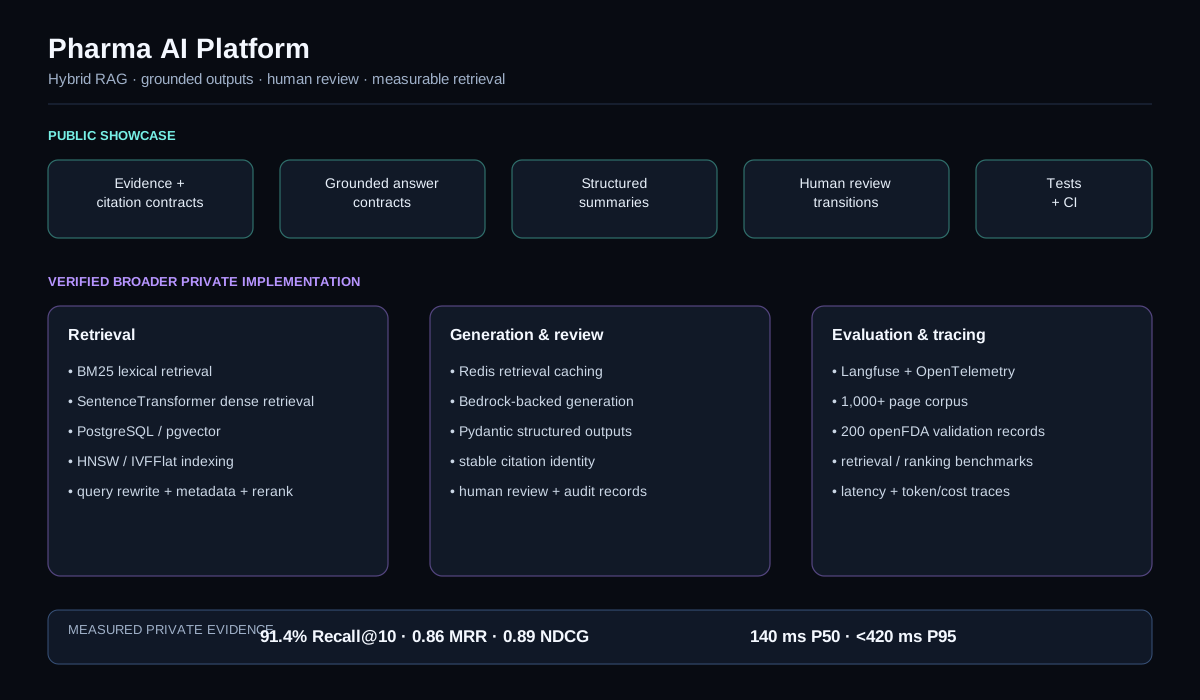
Grounded and traceable regulated-AI contracts
Reworked after dense similarity repeatedly returned passages that were related to a regulatory question but were not the evidence needed to answer it. The current design combines BM25 + PostgreSQL/pgvector hybrid retrieval, reranking, citations, review, and traced evaluation.
How do you retrieve the evidence that actually answers a regulatory question, then keep generation tied to that evidence through citations, review, and evaluation?
Selected engineering
Product engineering, governed retrieval, backend architecture and workflow reliability broaden the portfolio without duplicating the flagships.
Job intelligence and workflow product
Built on the rule that AI can assist the workflow without becoming the source of truth. An 11-entity relational model and deterministic rules own freshness, deduplication, permissions, and application state, while pgvector and LLM services assist matching and preparation.
Governed connector policy · Job normalization · Freshness classification
Next.js / React product architecture with an 11-entity PostgreSQL / Prisma source-of-truth model · PostgreSQL/pgvector semantic matching · Redis-backed workers and Kafka event-driven ingestion
Matching-quality benchmarks and workflow-completion evidence · Expanded load / latency and queue metrics · Additional end-to-end product evidence
Governed enterprise retrieval
Explores a simple but important boundary: a result can be relevant and still be the wrong information to show a requester. The system combines semantic retrieval with deterministic PII controls, role-conditioned behavior, grounded answers, and repeatable evaluation.
SentenceTransformer embeddings · scikit-learn cosine-similarity semantic retrieval · Deterministic PII redaction
Authorization-aware / RBAC retrieval · Recall@K, MRR, and NDCG · Leakage-rate measurement
Typed backend API and service architecture
Started from a deliberately narrower claim: finding a regulatory record does not prove a physical medicine is authentic. The service returns matched, not found, or ambiguous through typed FastAPI/Pydantic contracts and explicit service/source/repository boundaries.
FastAPI health and verification endpoints · Pydantic request / response contracts · Service-layer orchestration
Database-backed persistence · Real regulatory-data integration · Containerization
Workflow contracts and reliability-oriented state management
Models workflow reliability before infrastructure is added: explicit PENDING, QUEUED, COMPLETED, and FAILED states, idempotency requirements, queue eligibility, controlled transitions, and structured delivery outcomes.
Scheduled-work contracts · Queue eligibility rules · Idempotency-key requirements
Scheduler and worker runtime · Durable persistence · Retry / backoff policy
Technical surface
Publicly evidenced across the portfolio
Broader engineering experience
Portfolio principle
Public claims should map back to implementation, tests, architecture, evaluation, deployment evidence, or professional experience. Planned capabilities stay labeled as planned until they are verifiable.
Connect
Texas, USA · Open to Remote & Relocation. For opportunities, technical conversations, or project review, use any of the links below.